Sobre la relación entre los Cuéllar y Lizárraras y los Vargas Machuca

La identidad del “sobrino” Pedro de Vargas Machuca

 (Saltillo y San Luis Potosí, siglo XVII)

Resumen

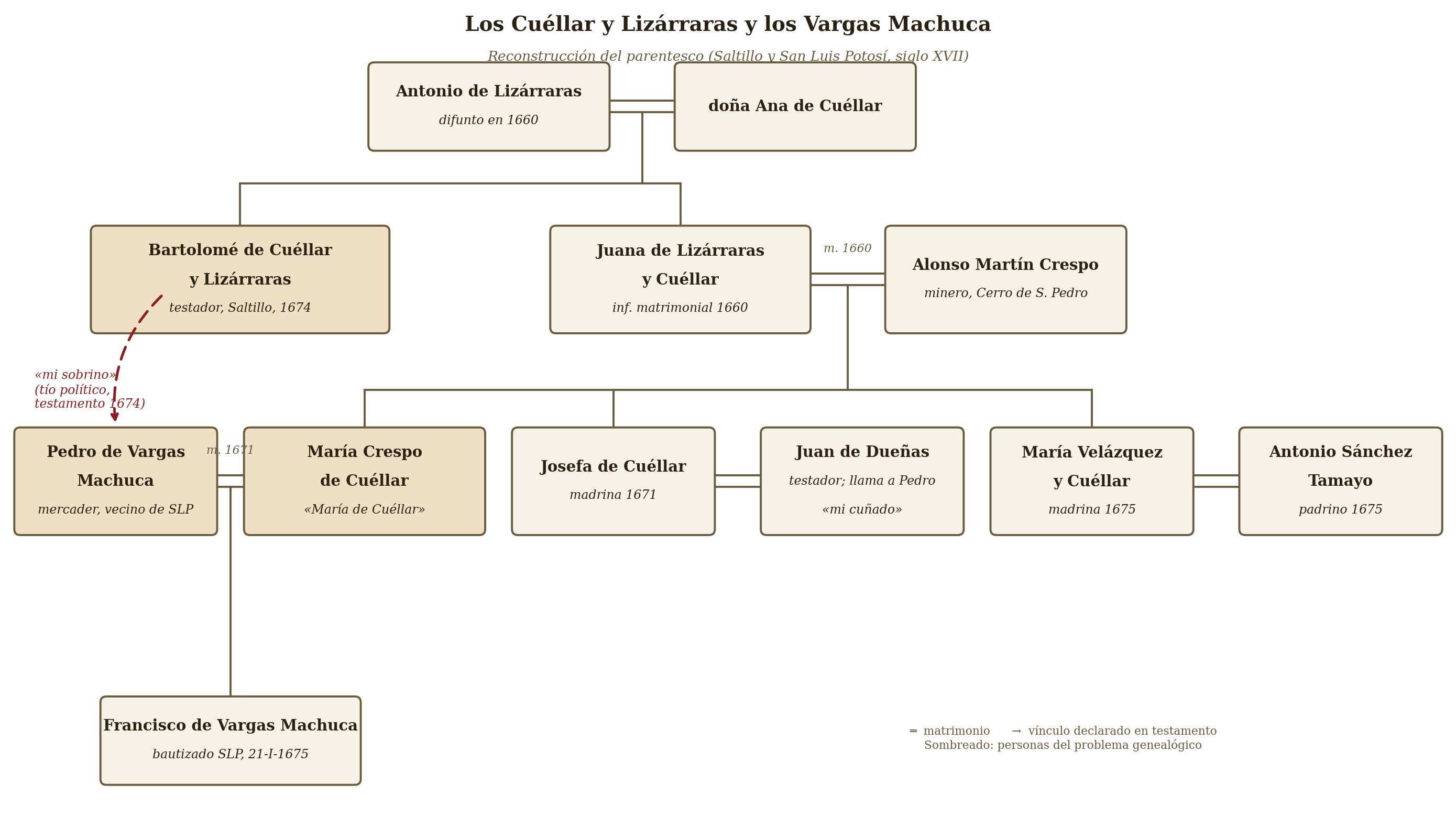
En su testamento de 1674, Bartolomé de Cuéllar y Lizárraras llama “sobrino” a Pedro de Vargas Machuca sin explicar el vínculo. Mediante el análisis correlacionado de registros sacramentales de San Luis Potosí, testamentos y protocolos notariales de Saltillo, este artículo demuestra que el parentesco era político: la esposa de Vargas Machuca, María Crespo de Cuéllar, era hija de Alonso Martín Crespo y de Juana de Lizárraras y Cuéllar, hermana del testador. El caso ilustra la resolución de un problema de parentesco mediante evidencia indirecta.
I. El problema

Bartolomé de Cuéllar y Lizárraras, vecino de la jurisdicción de Saltillo, otorgó testamento el 19 de febrero de 1674 en la hacienda de San Juan Bautista de la villa de Santiago del Saltillo, gobernación de la Nueva Vizcaya. Entre sus deudas menciona a un cierto Pedro de Vargas Machuca, a quien denomina expresamente “mi sobrino” [1] (figura 1). El documento no explica la naturaleza del vínculo. ¿Cómo era Pedro sobrino de Bartolomé? Ningún registro directo conocido establece la filiación de Pedro de Vargas Machuca ni la de su esposa; la respuesta debe construirse, por tanto, a partir de evidencia indirecta.

Figura 1. Fragmento del testamento de Bartolomé de Cuéllar Lizárraras (1674), AMS, T, c 2, e 10.

Transcripción:

“Y también declaro que le debo a Pedro de Vargas Machuca mi sobrino un mil quinientos noventa y cinco pesos de ajuste [y] liquidación de cuentas de avío que me dio de su tienda para dicho mi molino de fundición de esta hacienda, de que le hice vale.”

Continue reading “Sobre la relación entre los Cuéllar y Lizárraras y los Vargas Machuca”

The brothers Juan and Juan Diego GOMEZ de CASTRO

translator
Una traducción de esta publicación al español está disponible aquí.

  [Last Updated: 2 November 2019]

In an ideal world every genealogist would like to have parents name their children distinctly enough so as to avoid confusion when looking them up in the records. In the real world, for a myriad of reasons, parents oftentimes give their children very closely sounding names. This is the case of Juan and Juan Diego GOMEZ de CASTRO, two brothers who lived in Nuevo Leon, Mexico around the first half of the 18th century.

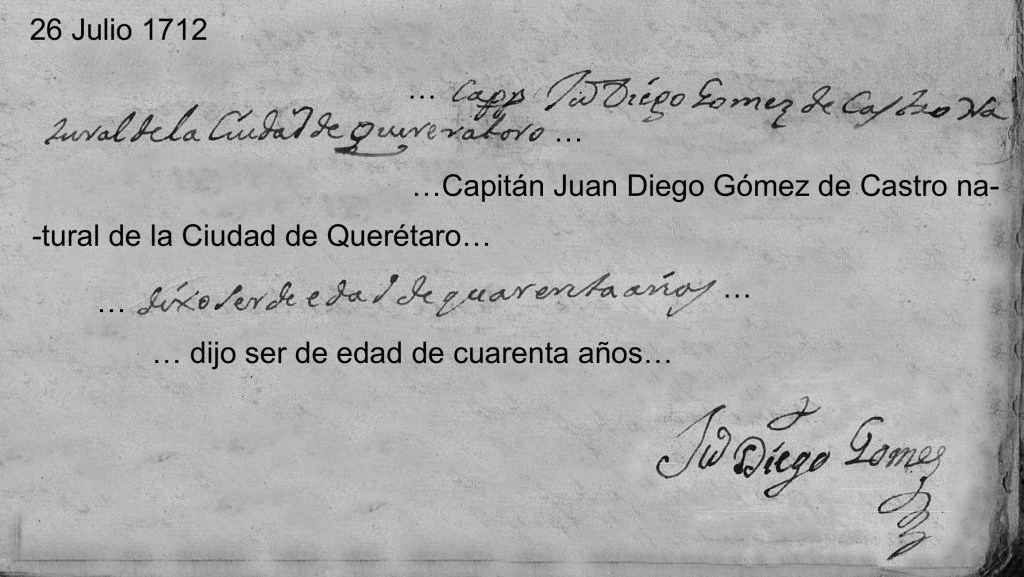
Juan and Juan Diego GOMEZ de CASTRO are the sons of Juan GOMEZ de CASTRO and Juana PEREZ VIDAL de FIGUEROA [1]. In one generation there are two children named Juan, and their father is also named Juan. It is clear here that there is plenty of room for confusion. Fortunately, there are rare moments in the records when two similarly named individuals make declarations side-by-side, and this sets the record straight if there was ever doubt as to their identities. Juan and Juan Diego GOMEZ de CASTRO appear as witnesses in the marriage dispensation [2] of Joseph de la GARZA and Isabel SALINAS which took place in Montemorelos, Nuevo Leon, Mexico on 25 July 1712.

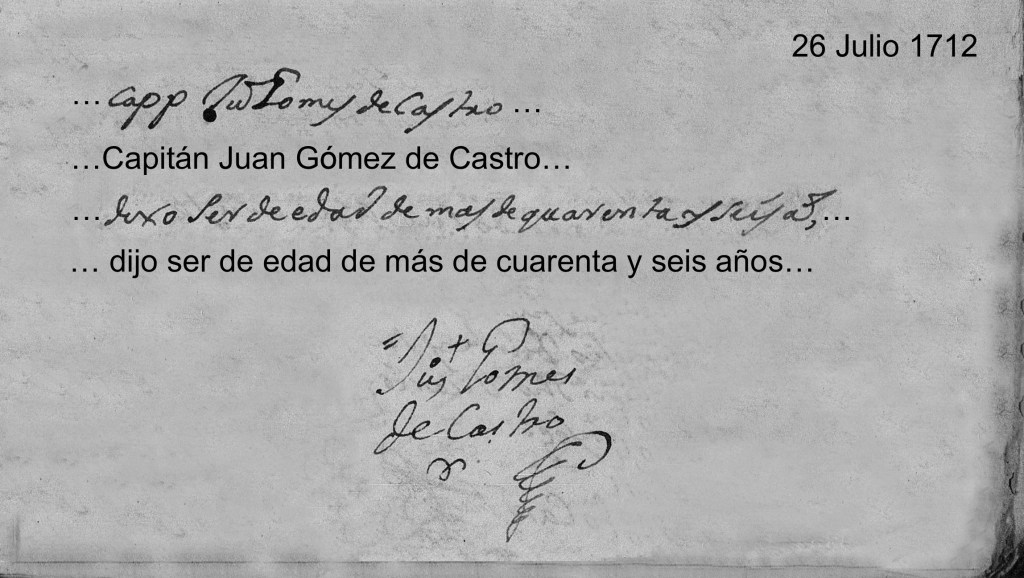
Juan Diego Gomez de Castro in 1712 Marriage Dispensation of Joseph de la Garza and Isabel Salinas

Both declarations include the ages and signatures of Juan Diego and Juan GOMEZ de CASTRO. Juan Diego was born about 1672, and Juan was born about 1666 or before. The signatures express not only their penmanship, but their literacy. They also communicate how they felt about the compound surname GOMEZ de CASTRO. Juan Diego signs simply as a GOMEZ while Juan signs as a GOMEZ de CASTRO. The declaration of Juan Diego is unique because it’s one of the few sources which confirm the origin of this family in Queretaro, Mexico.

Juan Gomez de Castro in 1712 Marriage Dispensation of Joseph de la Garza and Isabel Salinas

These declarations are found in a commonly overlooked source for biographical information: the witness declarations associated with marriage dispensations. For the region of northeastern Mexico and South Texas these marriage dispensations are easily accessed through the indispensable Index to the marriage investigations of the Diocese of Guadalajara pertaining to the former provinces of Coahuila, Nuevo Leon, Nuevo Santander and Texas [3]. Unfortunately, this index while extensive leaves out the names of the marriage dispensations’ witnesses.

Do you descend from the GOMEZ de CASTRO family of northeastern Mexico and South Texas? Please consider joining this Facebook group: Gomez de Castro (Genealogy and Genetics) at https://www.facebook.com/groups/GomezdeCastro/.

mail
Do you have a comment, correction or suggestion on this post?
Please contact me. I’d love to hear your feedback.
cc.xlarge
nc.xlarge
This work is licensed under a Creative Commons Attribution-NonCommercial 4.0 International License.

Sources

  1. Mendirichaga Cueva, Tomás. “Gómez De Castro.” Apellidos De Nuevo León : Siglos XVI, XVII y XVIII, pp. 161–177.
  2. Joseph de la Garza and Isabel Salinas – Church Marriage Dispensation. “México, Jalisco, registros parroquiales, 1590-1979,” database with images, FamilySearch (https://familysearch.org/ark:/61903/3:1:9392-6RS4-G8 : 28 June 2014), Guadalajara > Diócesis de Guadalajara > Matrimonios 1712-1718 > image 65 of 205; parroquias Católicas, Jalisco (Catholic Church parishes, Jalisco).
  3. Guerra, Raul J, Nadine M. Vasquez, and Baldomero Vela. Index to the Marriage Investigations of the Diocese of Guadalajara Pertaining to the Former Provinces of Coahuila, Nuevo Leon, Nuevo Santander and Texas. Edinburg, Tex.: University of Texas at Pan American, 1989. Print.